
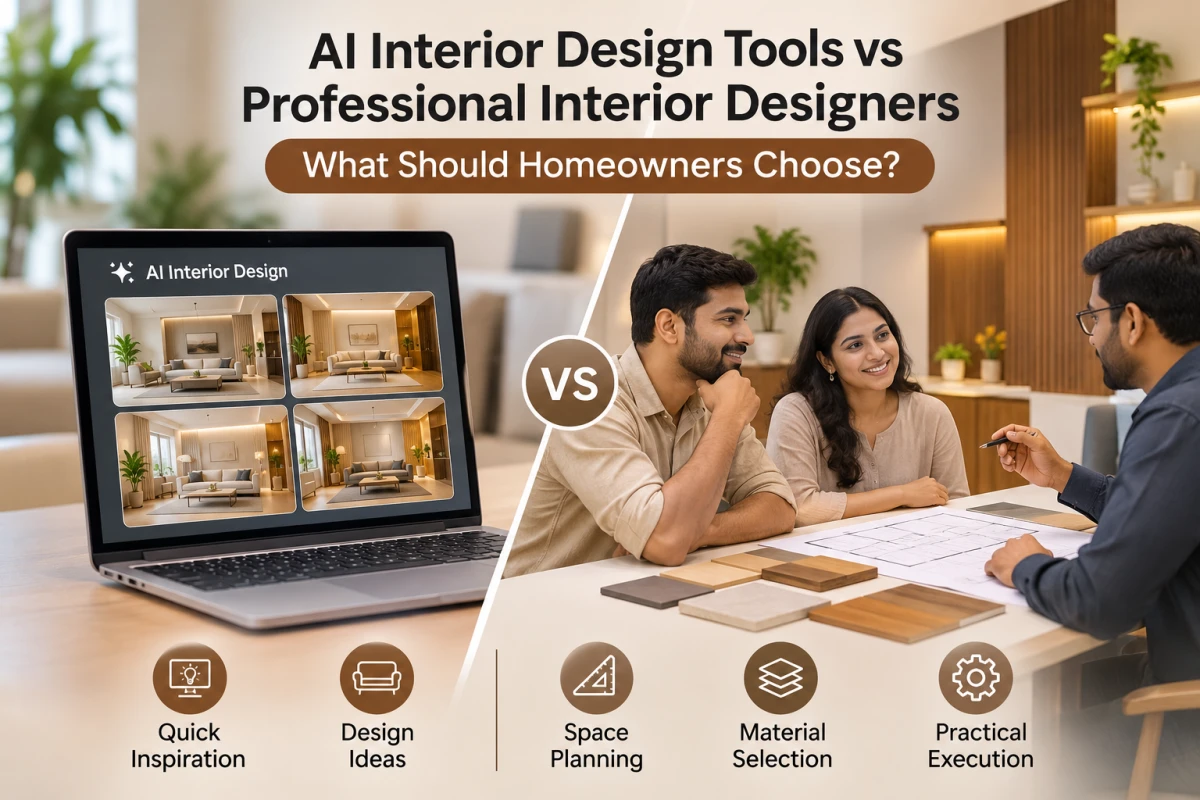
AI Interior Design Tools vs Professional Interior Designers: What Should Homeowners Choose?
Imagine finding a beautiful living room
design online and thinking, "This is exactly how I want my home to
look!"
Today, you don't have to spend hours
searching for inspiration. With AI interior design tools, you can upload a room
photograph, describe your preferred style and explore different design
possibilities within minutes.
But here's an important question: Can AI
actually design your entire home, or is working with a professional interior
designer still the better choice?
Both have their advantages. Understanding
what each one can do will help you make better decisions before starting your
home interiors.
1. How Are AI Interior Design Tools Changing the Way We
Plan Homes?
AI interior design tools have made it
easier for homeowners to experiment with different looks without having design
experience.
For example, imagine you have recently purchased a 2BHK apartment in Chennai. You are unsure whether your living room should have a minimalist look, wooden finishes or a more contemporary style.
You can upload a photograph of the empty room and ask an AI tool to generate different concepts.
Some tools can help you:
·
Explore different interior design styles.
·
Experiment with wall colours and furniture
combinations.
·
Visualise different lighting moods.
·
Generate living room, bedroom and kitchen
inspiration.
· Compare design concepts before making decisions.
Tools such as Adobe Firefly and AI-powered room visualisers can help turn written descriptions or photographs into interior design concepts.
This makes AI particularly useful during the initial inspiration stage, when you are still discovering what you like.
2. What Can AI Interior Design Tools Do Well?
One of the biggest advantages of AI is speed. Instead of trying to imagine how a particular colour or furniture style might look, you can generate visual alternatives.
Consider a bedroom.
You may want a modern bedroom with a wooden wardrobe, soft lighting and neutral wall colours. However, you might not know whether beige, cream or light grey would look better.
AI can help you explore these combinations and compare different visual directions.
It is also useful when communicating ideas. Sometimes, explaining a design through words can be difficult. Showing a reference image makes it easier to communicate your preferences to an interior designer.
However, remember that an AI-generated image is a visual concept, not a complete interior design plan. The actual dimensions, materials and execution requirements still need to be checked.
3. Where Do AI Interior Design Tools Fall Short?
This is where homeowners need to be careful.
An AI-generated room can look stunning on screen, but that does not automatically mean the design will work in a real home.
For example, an AI tool might generate a beautiful kitchen with a large island counter. But will that island fit comfortably in your apartment while leaving enough space to move around?
Similarly, a generated bedroom may show a large wardrobe, decorative panels and a king-size bed. Once the actual room dimensions are considered, the layout might become impractical.
AI-generated concepts may also:
·
Change the original position of windows or doors.
·
Show furniture in unrealistic proportions.
·
Suggest finishes that may not be available locally.
·
Overlook electrical points and functional
requirements.
·
Generate attractive lighting effects without a
practical lighting plan.
·
Fail to account for your actual budget and material
specifications.
These limitations are important because a home is not just something to look at. It is a space you will use every day.
4. What Does a Professional Interior Designer Bring to the Table?
A professional interior designer looks beyond the appearance of a room.
Before suggesting a design, they need to understand the available space, your lifestyle, storage requirements, preferences and budget.
Let's take the example of a family moving into a new 3BHK apartment.
The family may want a stylish living room, a functional kitchen, comfortable bedrooms and sufficient storage. Each room has different requirements, and the overall design needs to feel connected.
A professional designer can help with:
·
Space planning: Understanding room
dimensions and planning furniture, wardrobes and storage according to the
available space.
·
Material
selection: Recommending suitable materials, finishes, laminates, hardware and
other specifications based on requirements and budget.
·
Functional design:
Ensuring
that furniture placement, storage and everyday movement are considered.
·
Lighting planning:
Deciding
where ambient, task and accent lighting will be useful.
·
Design
coordination: Bringing different rooms together through consistent colours, finishes
and design elements.
· Execution planning: Translating design concepts into detailed requirements that can be communicated to the people responsible for carrying out the work.
The real value of a professional designer is not just creating an attractive room. It is making sure that the design makes sense for the people who will live there.
5. AI vs Professional Interior Designers: Understanding the Difference
Both have a place in the interior design process, but their responsibilities are different.
|
Requirement |
AI Design Tools |
Professional Designer |
|
Design
inspiration |
Very useful |
Very useful |
|
Exploring colour
combinations |
Useful |
Useful |
|
Generating
visual concepts |
Quick |
Based on design
process |
|
Actual room
measurements |
Needs
verification |
Professionally
assessed |
|
Material
selection |
Suggestions only |
Based on
requirements and specifications |
|
Storage planning |
Limited without
accurate inputs |
Planned around
actual needs |
|
Budget planning |
Cannot guarantee
accurate project costs |
Can prepare
project-specific estimates |
|
Practical
execution |
Not handled by
visualisation alone |
Can coordinate
design and execution requirements |
6. The Smartest Approach: Combine AI Inspiration with Professional Expertise
You don't necessarily have to choose one over the other.
In fact, using AI before meeting an interior designer can make the initial discussion more productive.
Here is a simple example.
Imagine you prefer a warm, modern living room with wooden finishes and soft lighting.
You can use an AI tool to create a few reference images showing different versions of this style.
Once you have selected your preferred direction, share those images with your interior designer.
The designer can then discuss:
·
Which elements suit your actual room dimensions?
·
What materials can achieve a similar appearance?
·
How should the lighting be planned?
·
What furniture and storage arrangements are
practical?
· How can the design fit within your budget?
This way, AI helps you communicate your
taste, while professional expertise helps shape the final design.